Vasily Georgievich Yarkov
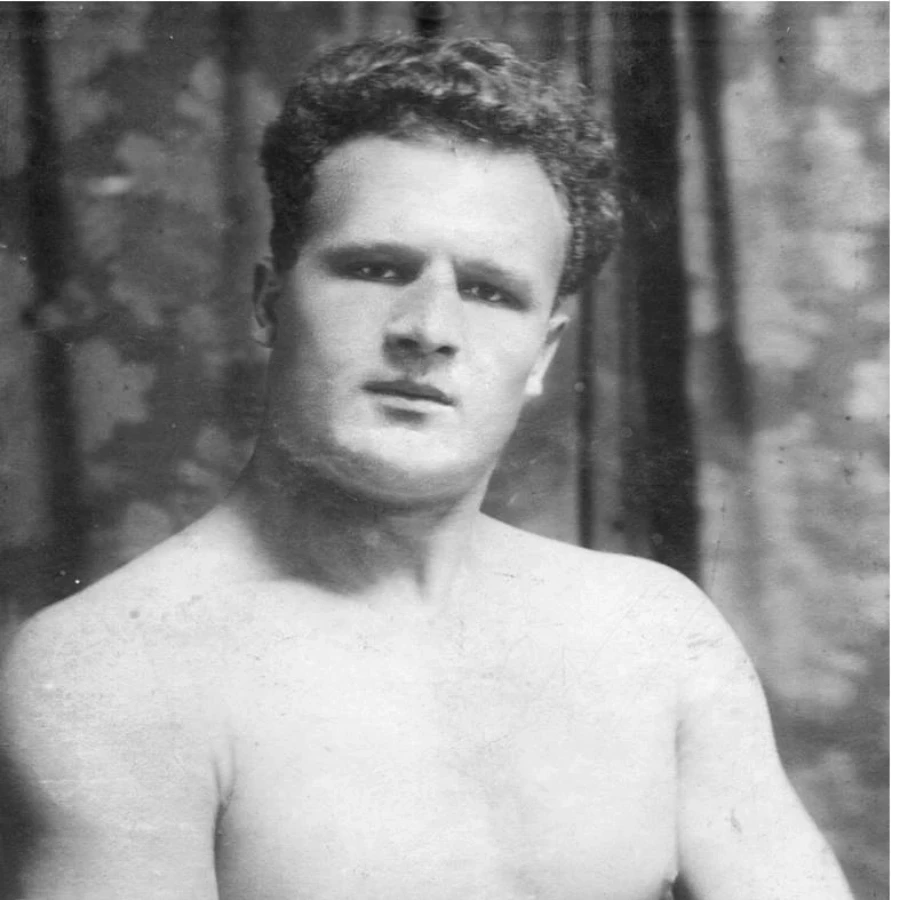
Vasily Georgievich Yarkov was a highly qualified professional wrestler and a Master of Sports of the USSR in Greco-Roman wrestling. He was born on January 13, 1911 in the village of Novo-Pokrovka, Semey region.
Vasily Yarkov grew up in the village of Novo-Pokrovka, in a simple, large peasant family, where children were taught to work from an early age. From an early age, he began to amaze everyone with his great strength. At the age of nine, he became an experienced woodcutter, preparing to split firewood with his father. When he grew up, he worked as a hammerman in a blacksmith's workshop. In the village, he was known as an invincible belt wrestler. When he went to the city with his parents, he always went to the circus. There he first saw professional wrestlers demonstrate a cascade of various techniques, their athletic physique and enormous strength.
In 1929, the Yarkov family moved to Semey. Vasily began working as a loader at the Soyuztrans company. Everyone in the "Tyazhelovoz" brigade was amazed by his enormous strength: he lifted heavy loads like toys and easily lifted two-pound weights. His cousin Konstantin introduced Vasily to Mikhail Romanovich Borov, a famous circus wrestler who had performed for a long time in the Semipalatinsk circus, the first champion of the RSFSR. Borov liked the young athlete and invited him to train. After appropriate training, Yarkov made his debut at the Semipalatinsk circus championship. The audience warmly welcomed his compatriots. Wrestling fans in Chelyabinsk discovered a newcomer. Thus began his circus career as a professional wrestler. Vasily Yarkov performed in the circus from 1931 to 1961. From 1946 to 1950, he won the title of All-Union Central Council of Trade Unions three times and the All-Union Championship of the Society of Bolsheviks twice. In 1957, he was awarded the title of Master of Sports of the USSR.
Vasily Yarkov met many famous wrestlers on the mat. He became close friends with the world-famous Russian wrestler Ivan Maksimovich Poddubny. The veteran and the young athlete trained together and participated in championships in Tula, Baku, Zaporozhye and Dnepropetrovsk. In Baku, their match ended in a draw, but in 1934, in Rostov-on-Don, Vasily Yarkov won.
At the beginning of his career, Yarkov met with the famous Kazakh batyr Kazhymukan Munaytpasov. They first met in Semipalatinsk, and then competed at championships in Frunze and Omsk.
Yarkov also successfully competed with a number of foreign wrestlers. He met with Czech, Bulgarian and German wrestlers. He performed various strength exercises, such as bending an iron beam over his shoulders and even fighting a bull (a circus performance at that time). As one of the most respected performers, he served on the artistic council of the Soyuzgoscirk.
After 30 years of work in the circus arena, Yarkov retired and returned to Semipalatinsk in 1961.
Vasily Yarkov was awarded with Certificates of Honor for brilliant victories in Saratov and Tashkent, Penza and Tallinn, Magnitogorsk and Krasnoyarsk, Irkutsk and Tyumen, Frunze and Simferopol, Riga and Kazan, Novosibirsk and Chelyabinsk. Vasily Georgievich's archive contains certificates of honor for participation in patronage concerts in military units and training wrestlers in physical education organizations in Tashkent, Kirov and Krasnoyarsk.
From a young age, he worked as a porter in the city of Semey. Known for his enormous strength, he regularly participated in belt wrestling at weddings and holidays.
In 1931, the young wrestler was noticed by I. Poddubny and took him as his student.
For several years he performed in the circus arena. In 1934, he defeated his teacher Poddubny in Rostov.
The most difficult types of weightlifting - breaking horseshoes, hammering nails with his fist or pressing them with his finger into a board, bending thick belts around his neck
He continued his circus performances during the Great Patriotic War. He donated all the money he earned from his victory in the championship in Nizhny Tagil to the Defense Fund.
After the war, he also participated in amateur competitions. He became a three-time champion in the trade union classical wrestling competitions, which were considered the junior championship of the Union.