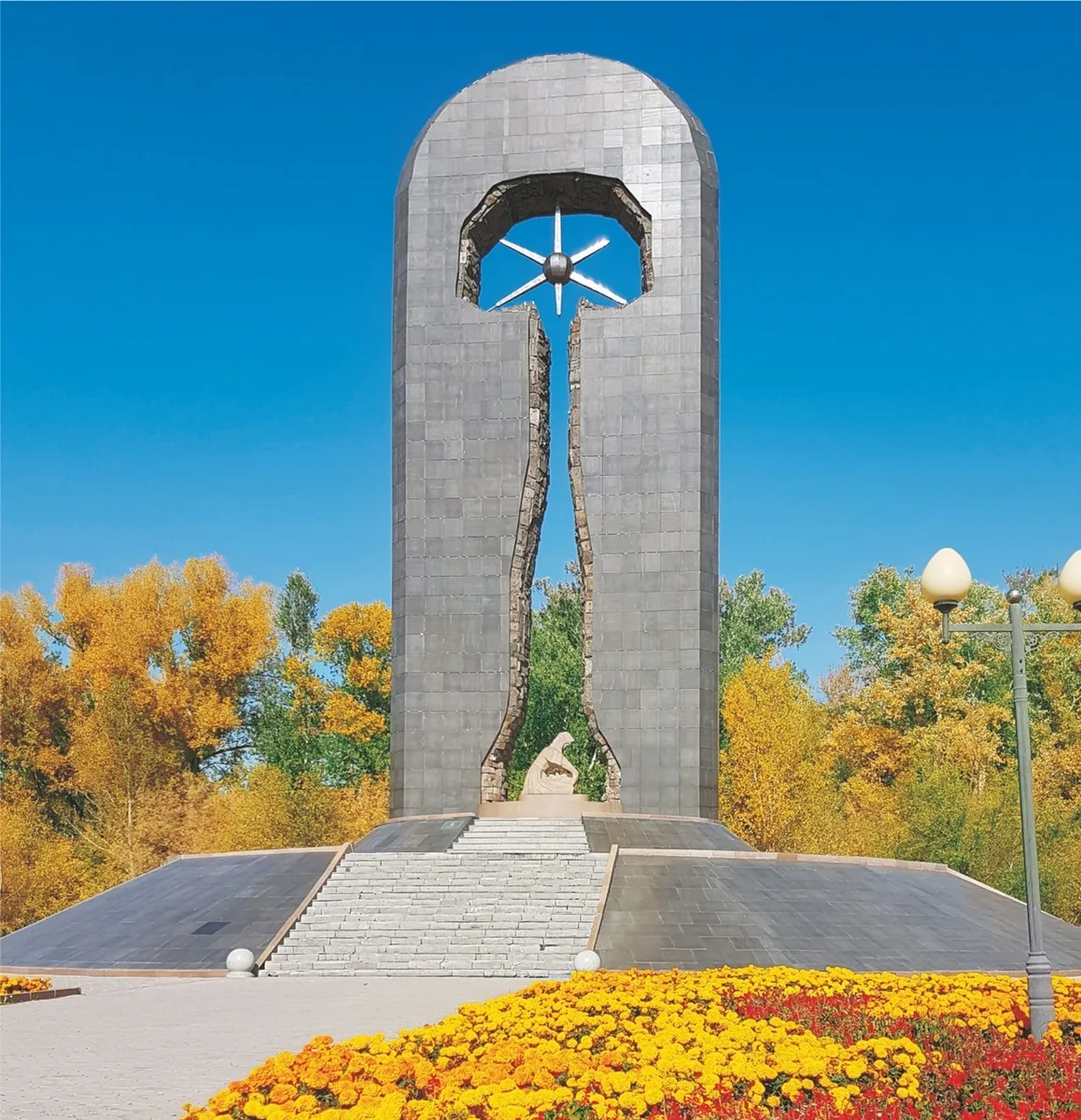
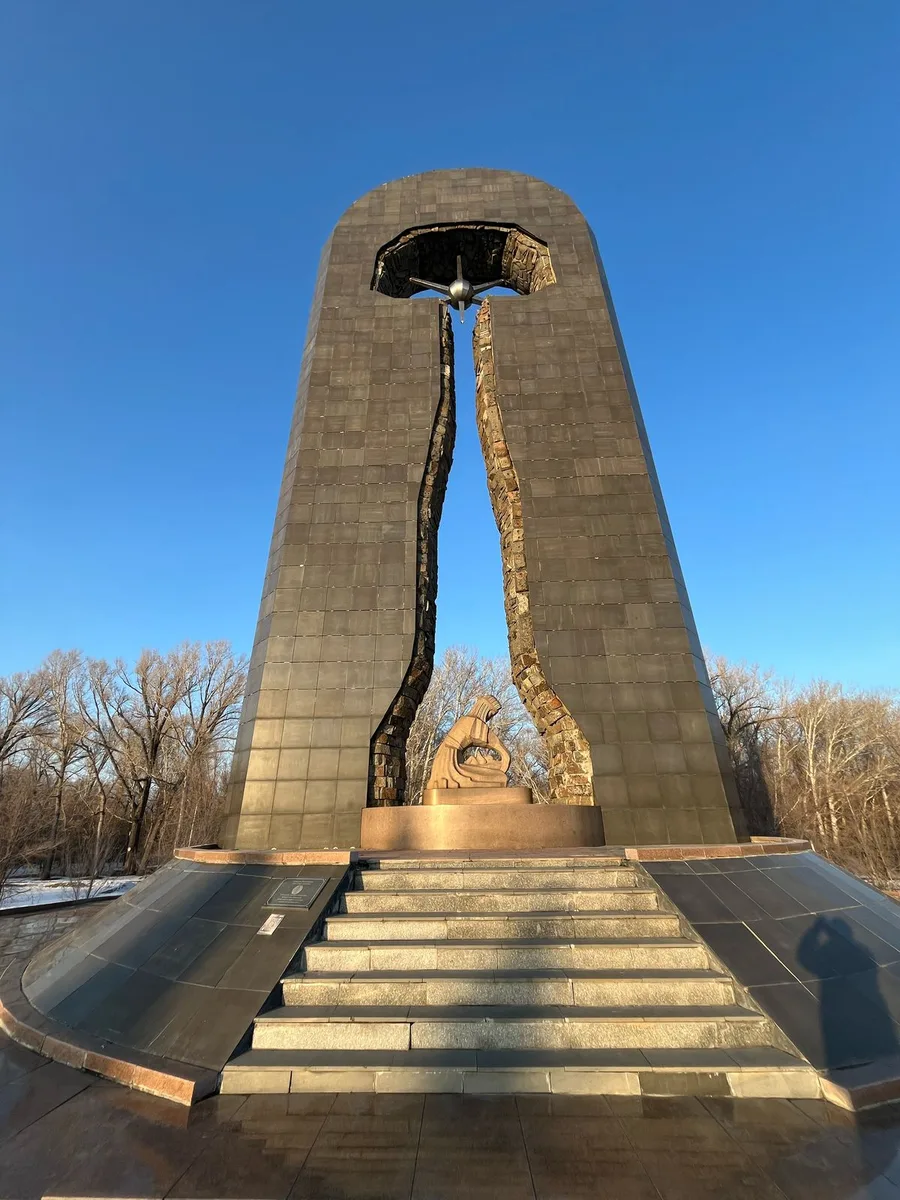
Monument "Azhaldan da Kushti" – an important symbol for the people of Kazakhstan. It commemorates the victims and losses of nuclear tests conducted between 1949 and 1963. The monument is located in a large square, accessible via radial-light paths. The entrance to the memorial is in the southwest, flanked by winged leopards that protect against evil forces in popular belief. The main element is a 25 m tall, rounded-top stela, featuring the image of an "atomic mushroom." The stela is made of reinforced concrete, clad in black semi-granite, measuring 10.3 m in width and 2.45 m in thickness. In the center of the mushroom image, there is a composition depicting a round sphere representing a nuclear explosion and rays ranging from 0.5 to 2 m in length. At the bottom, there is a statue of a mother embracing her child (2.07 m tall, with a pedestal height of 0.4 m).
Historical data
Semey nuclear test site was established in 1947. The first test was conducted in 1949, and over the next 40 years, 494 explosions took place. In 1991, Kazakhstan voluntarily renounced nuclear weapons, and the site was closed. In 2001, the "Stronger than Olympus" monument was unveiled on "Polkovnichiy" island in memory of the victims of the Semey nuclear test site. At the bottom, there is a statue of Mother made of white marble, depicted as a symbol of love and courage for life. The author is architect-sculptor Shokan Ualihanov. The monument was installed in accordance with the Government of Kazakhstan's decree No. 556 of 2001.